













Frequently Asked Questions
(FAQ)

Learn from
Home
Self Defence Frequently Asked Questions
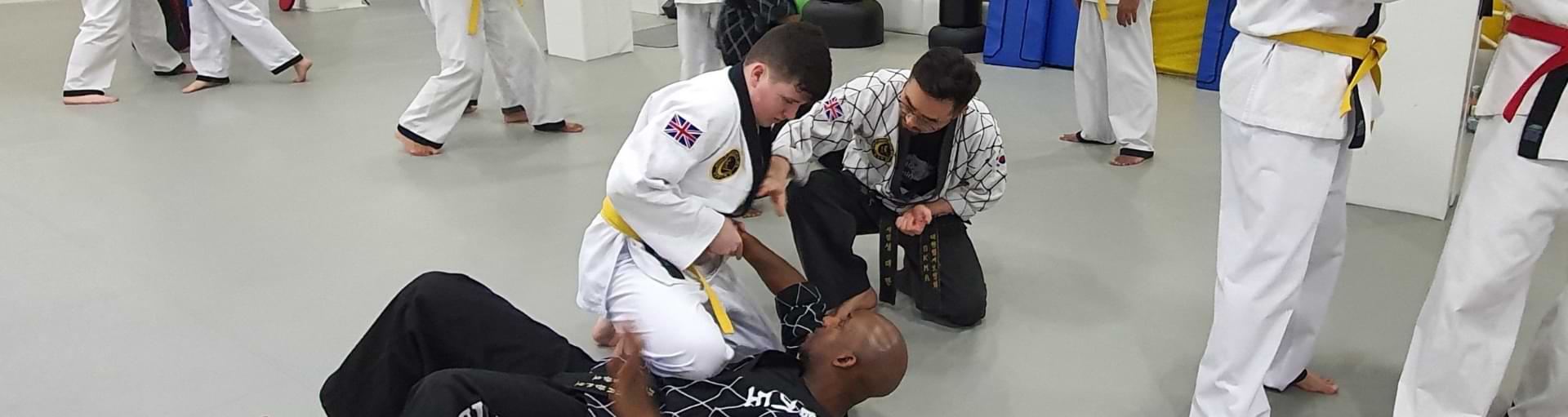
Here are some frequently asked questions about Hapkido as an incredibly practical self-defence system. Remember, we are a real school in London, and you can always contact us directly and in person if you have any more complicated questions.
They are very simple. You study from home. When you feel ready, you book an online grading test (certification examination) and follow the instructions in the course.
Yes, but as you might imagine, one 30 min video lesson is more expensive than the entire course. But it's still good to know you can meet Master Sung either online or in person and that he is real and has the best Dojang in the UK for Hapkido.
We recommend practising at least twice a week, 1 hour per session, ideally 3 times weekly. If you practise 3 times a week, you’ll progress quicker.
If you practise twice a week, you should be able to complete a course in 3 to 4 months.
Our programmes link, and in each advanced course, you’ll build up on the fundamentals. We recommend continuity.
Yes, you can, especially if martial art forms are different. However, if the martial arts are very similar, you might find it challenging to differentiate the techniques.
We recommend that you learn Korean terminology. It will help you to understand the culture and techniques better.
As with any health condition or known injury, you should consult your healthcare provider before starting physical training, especially if you are pregnant or have a known medical condition.
Yes. Please disclose the disability, and we will tailor your grading, methods and techniques.
Hapkido training is cardio-based training. It might be helpful for your weight loss training. As with any health condition or known injury, you should consult your healthcare provider before starting physical training.
As with any health condition or known injury, you should consult your healthcare provider before starting physical training, especially if you are pregnant or have a known medical condition.
We recommend that you drink water before and after the training.
It depends on your confidence and regularity of training. Even the white belt course can be helpful. You need to master muscle memory and learn the techniques.
To progress in Hapkido, you need a training partner. This course is designed for adults, so you will need an adult partner (16 years plus) to assist you during the grading and practice. If your training partner is interested in purchasing the course, please get in touch. However, your partner (mum, dad, wife, friend, neighbour or colleague) doesn’t need to pass the exam.
We recommend kick pads, a kick shield and a soft yoga mat.
Hygiene is important when practising with other people. It is respectful towards your training partner. Your nails must be short so you won’t hurt yourself or your partner. Please also remove the jewellery before your training due to security reasons. You can wear glasses, but they must stay on when you move.
We recommend a warm-up drill and stretching daily.
Age is not an issue, but you must be fully grown to practise adult techniques. The minimum age is 16 years. Our oldest student is 65 years old.
We plan to launch Hapkido courses for children, so watch the space and follow us on social media.
We would be happy to meet you and welcome the idea of passing the grading in our Dojang. This would be the best outcome.
No, we can’t refund the course once the videos are shared.
You will get one more chance free of charge. After that, you can submit the videos again. If you fail, you will need to pay for the extra grading.
We will advise you what a suitable time to repeat the techniques and grade again is.
Once you pass the grading, you can enrol in the next course.
We will send you an online certificate. If you are based in the UK, we can also send you a hard copy certificate for an additional cost.
Shouting can release pent-up energy and tension, helping you generate more power and force in your techniques. The sudden exhalation of breath can enhance the effectiveness of your strikes.In some martial arts, shouting can be used to intimidate opponents. A loud, forceful shout can create a psychological impact on your opponent, making them hesitate or become unsettled.
Yes. Shouting serves as a form of communication between you and your training partners or instructor. For example, during partner drills or sparring, a shout might signal that you're about to attack or defend. Kihap is a common term in many martial arts, including Hapkido. A Kihap is a loud shout or vocalisation made during a technique or strike. It's often used to focus your energy, intimidate an opponent, or exhale forcefully during a movement.
This is a safety measure to prevent injury, as the tap signals to the opponent to release the hold immediately. When you train with your partner and it hurts, please tap and stop.
If you realise that you've hurt your partner, stop the activity immediately to prevent any further injury. Check on your partner's well-being and assess the extent of the injury. If the injury seems serious, seek medical attention promptly.
Please reach out to our support team and provide a detailed description of the issue you're experiencing.